

From the 23d of May till the 29th of August 2021, Rijksmuseum Twenthe will be exhibiting paintings from the Danish Golden Age: over fifty highlights from the Nivaagaard Collection by Christoffer Wilhelm Eckersberg, Christen Købke, Martinus Rørbye, Thomas Lundbye and others. Painters who, in the first half of the 19th century, in times of crisis, emphasized the national unity. Because it is especially when things are rough that the need for beautiful stories is great.
A paradox
A 'Golden Age' is a label that is usually applied retrospectively to a period in the past; a moment in
history when something extraordinary happened. Golden Ages are proclaimed in times when there is a need for a unifying factor, for a good story in which a brilliant, glorious, national past can be
recalled. But with the Danish Golden Age - which lasts not a full but about half a century - something remarkable is going on.
For the beginning of the 19th century is anything but glorious for Denmark. Denmark is a world
power in decline: wars lost without a trace, the loss of almost the entire fleet, a painful divorce with Norway, the crumbling monarchy and a state bankruptcy. Denmark is a shadow of its former self, a country on the brink of collapse. It is precisely this period that is proudly marked as a Golden Age.
Repair by the imagination
The Danish Golden Age is not a surreptitious looking back at a lost past, but rather a repair carried
out by the imagination. From the ashes of a country in crisis, art, literature and science are rising in a golden age that must take the Danish people by the hand. The philosopher Søren Kierkegaard, for
example, is one of the founders of modern existentialism, the writer Hans Christian Andersen is still one of the most famous writers in the world, and the name of Hans Christian Ørsted is forever linked to the discovery of electromagnetism.
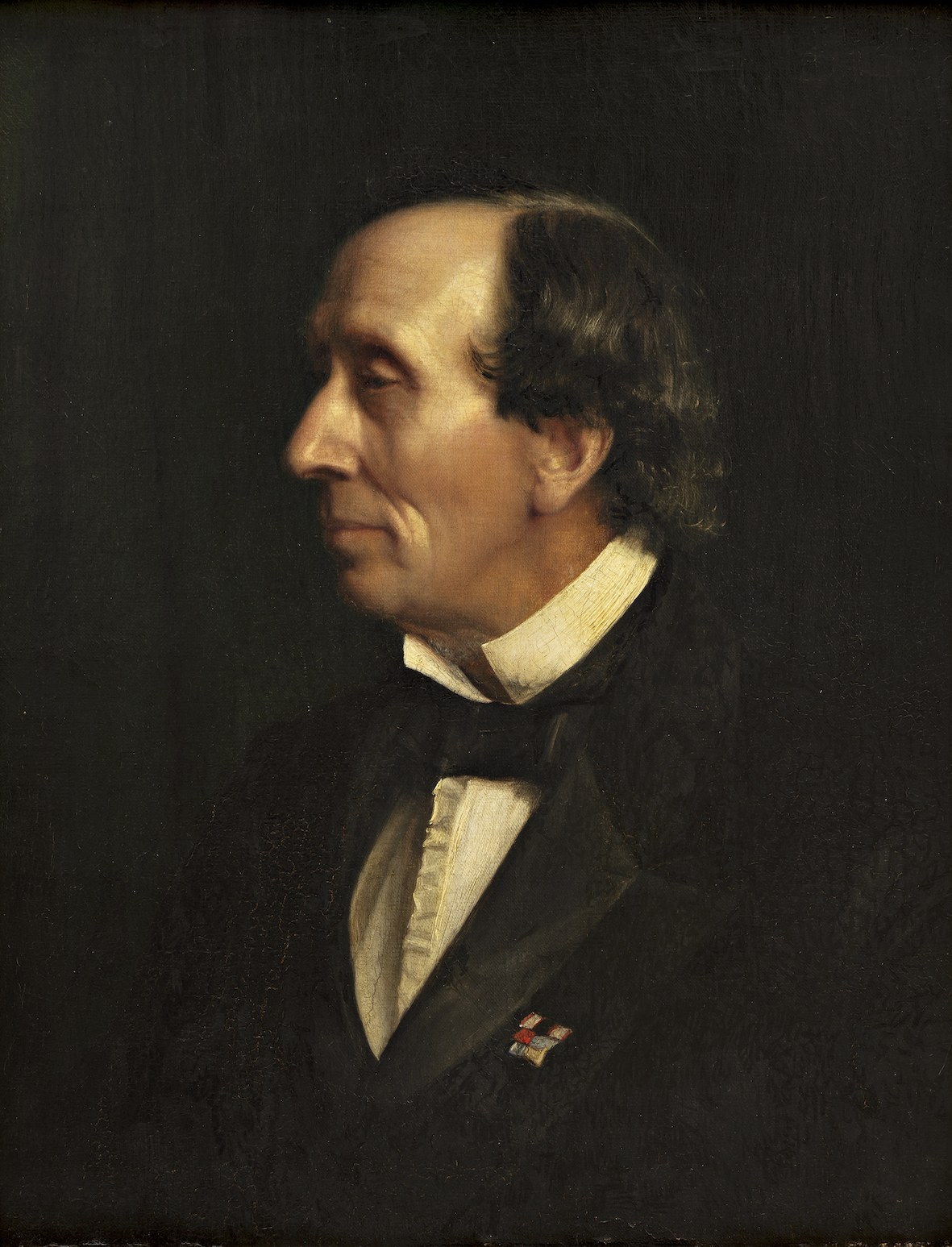
Carl Bloch, Portrait of Hans Christian Andersen, 1869. Oil on canvas, 64 x 50 cm
Nationalistic sentiment
Danish painting also contributed to the 'golden age', with the painter Christoffer Wilhelm Eckersberg at its base. After making a name for himself abroad, he returned to Denmark and showed his nationalistic side. For Danish life, which has traditionally been multilingual and multicultural, is - as is also happening elsewhere in Europe - becoming increasingly nationalistic. Looking inwards, artists are increasingly judged by their origin and the extent to which they perpetuate the country's selfimage. A nationalistic sentiment that belongs to a Golden Age and is expressed in paintings and the use of nationalistic motifs that emphasise the authentic Danish character.
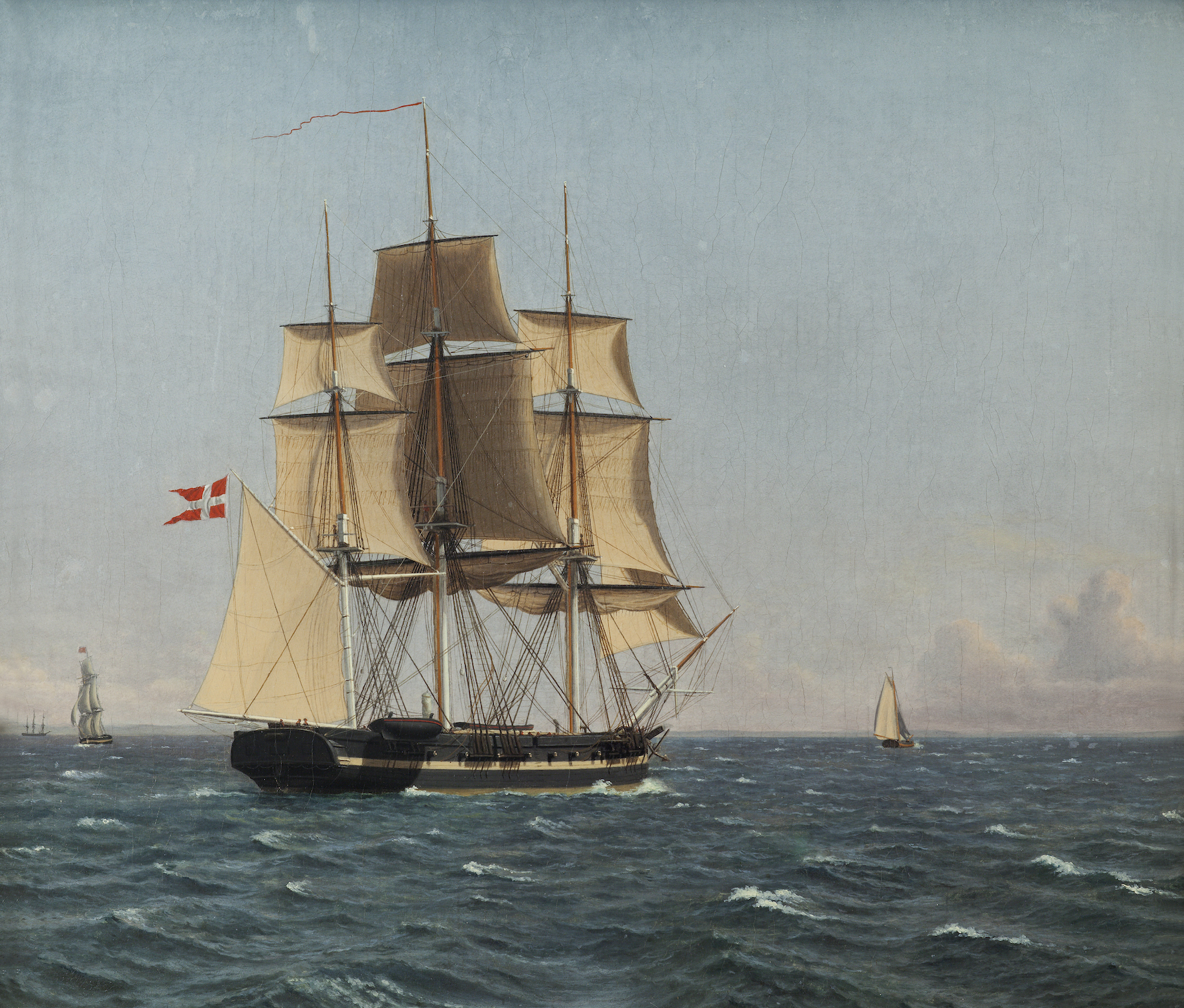
Christoffer Wilhelm Eckersberg, The corvette 'Najaden', c. 1834. Oil on canvas, 48 x 55.5 cm
Pride and Ideal
Eckersberg and a new generation of talented painters, including Christen Købke, Martinus Rørbye
and Thomas Lundbye, still draw their inspiration from abroad - Italy is especially popular - but they
increasingly focus on themes that belong to their own Denmark. Thus, after the loss of the fleet, a
nation can draw hope from a new naval ship immortalised in a painted seascape; iconic Danish
landscapes - the rolling fields of Jutland or the chalky coasts of Stevns - are actually just as
picturesque as places elsewhere in Europe, and represent the Danish identity in their simplicity. And so the painted rural idylls are a romantic idealisation of the modest life in the Danish hinterland. These paintings show themes that resonate well with a new clientele: the bourgeoisie. It is art that conveys the self-image of a people and a nation that have to reinvent themselves.
But the Danish Golden Age is more than just Danish. It illustrates the transition to modern Europe. In an idiosyncratic bringing together of the international neoclassicism of the 18th century and the
inward-looking romanticism of the 19th century, a progressive art of painting emerges. Paintings that tell new stories, an idealised realism that precedes later modernism. A unique moment in history.
Exhibition
In this exhibition, Rijksmuseum Twenthe is exhibiting over fifty works from the Nivaagaard Collection.Important representatives of this flowering period in Danish painting, such as Eckersberg, Købke,Rørbye, Hansen, Roed and Marstrand, and a younger generation of painters such as Lundbye andSkovgaard, are represented. In this way, the museum shows a cross-section of the 'golden age' forDenmark, and the paintings provide an insight into the paradox that lay behind it. The exhibition is acollaboration with the Nivaagaard Collection, Nivå, Denmark.
The Nivaagaard Collection
Just as the influential textile family Van Heek forged plans at the start of the 20th century to found the Rijksmuseum Twenthe in Enschede, Danish industrialist and politician Johannes Hage founded the Nivaagaard Collection in 1908. In the small town of Nivå, north of Copenhagen, he exhibitedGolden Age paintings from his own collection: masterpieces from the Italian Renaissance and the17th century Dutch, and paintings by fellow countrymen from the first half of the 19th century: guldalderen, or Golden Years, known in the Netherlands as the Danish Golden Age.
Publication
A richly illustrated publication will accompany the exhibition, with contributions from Andrea Rygg
Karberg, Birgitte von Folsach, Henk van der Liet and Tim van Gerven. The publication has been
published by Uitgeverij Waanders & de Kunst in collaboration with Rijksmuseum Twenthe.


