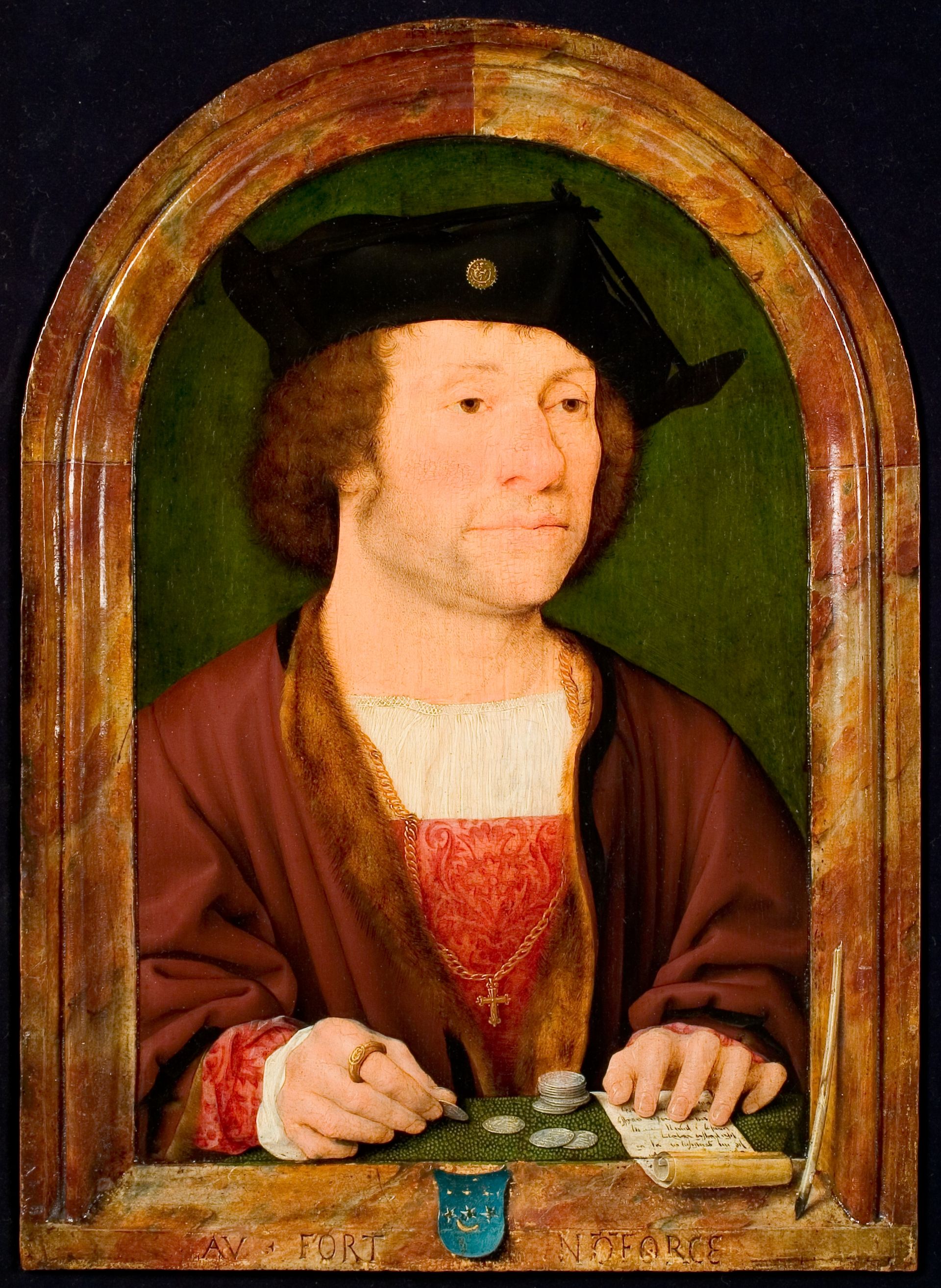

Husband and wife. We know little more than that. They have not been able to this day to identify the coats of arms at the bottom on the frame. The couple certainly belongs to the social upper class, judging by the rich dress and the abundance of jewellery. Unknown however does not mean unloved in this case. The highly detailed style of painting that Joos van Cleve used still speaks to us to this very day.
Special frames
Joos van Cleve (circa 1485 - 1540/1541) was born, as his name already says, around 1485 in or near the German city of Cleve. Later he left for Antwerp to develop his career as a painter. These two portraits were made by him around 1520. The man and woman who are depicted here were probably husband and wife, but more is not known about them. The paintings have a special place in the oeuvre of Van Cleve. The frames, which were made from the same oak as the panels, are decorated with a marble pattern, something which is hardly ever seen in portraits from this period. Just as unique is the trompe-l'oeil of the grapevines and goose feather on the frames, so that it looks as if the depicted scenes are continuing outside their borders.
The bunch of grapes and the counted money
The meaning of the bunch of grapes which the woman has in her hand is still being debated. In contemporary religious scenes of the Virgin Mary with child, the bunch of grapes is often a symbolic allusion to the Eucharist. Whether the bunch of grapes has a specific Christian meaning here is uncertain. It has been suggested that the grapes and the grapevine are intended to emphasise the piety of the woman. In that case the man is the ‘earthly counterpart’ in that he is busy with less lofty matters such as counting money. But the latter could also be an allusion to the profession of the man. Van Cleve had many merchants in his clientele.